Viscose (Rayon)
Updated Aug 19, 2026 10 mins read
Edited by Urša Satler
Some retailers on this page pay us a commission when you buy through our links. It costs you nothing, and it never affects our rankings or filtering. Learn more
Check the tag on a silky blouse or a drapey summer dress and there's a good chance you'll find the word viscose (or, if you're shopping in the United States, rayon). Same fiber, two names. It starts life as a tree, so brands love to describe it as plant-based, natural, even eco-friendly. Here's the honest version: viscose is a semi-synthetic fiber, and on MaterialFilter it does not count as natural.
That doesn't make viscose bad: it's soft, it breathes, and it isn't plastic. But "made from plants" and "natural fiber" are two very different claims, and the gap between them is exactly what this page is about.
Key takeaways
- Viscose and rayon are the same fiber. "Rayon" is the American name, "viscose" the European one. Bamboo viscose, modal, and lyocell are all members of the same family.
- Viscose starts as wood pulp but is dissolved in strong chemicals (caustic soda and carbon disulfide) and rebuilt into thread. That chemical rebuild is why it's classed as semi-synthetic, not natural.
- Carbon disulfide is genuinely toxic to the workers who handle it, and how much escapes depends on how well a factory recovers its chemicals. The EU's Best Available Techniques rules are the benchmark clean plants aim for.
- Lyocell (often sold as TENCEL) is the cleaner cousin: a different solvent, recycled in a closed loop. Still not a natural fiber, but a much tidier process.
- Unlike polyester, viscose is cellulose, not plastic; it absorbs moisture, breathes, and breaks down in nature far faster than synthetics. Its weak spots: it loses strength when wet and needs gentle care.
What is viscose, and is it the same as rayon?
Viscose is a regenerated cellulose fiber: cellulose from plants (usually wood) that has been chemically dissolved and re-formed into thread. The industry calls this family "man-made cellulosic fibers," or MMCFs. It's a big family: Textile Exchange puts MMCFs at roughly 6% of global fiber production, the third-largest group after polyester and cotton, and viscose is by far the biggest member.
And yes, viscose and rayon are the same thing. The fiber was invented in Britain: chemists Charles Cross, Edward Bevan, and Clayton Beadle patented the viscose process in 1892, and commercial production began in the early 1900s. For decades it was marketed as "artificial silk," until the U.S. industry adopted the invented word "rayon" in 1924. Europe kept calling it viscose, after the honey-thick ("viscous") solution the fiber is spun from. So an American care label says rayon, a European one says viscose, and the garment is identical.
One legal wrinkle worth knowing: in the U.S., rayon is the umbrella term under textile labeling law, with lyocell recognized as a sub-type. In the EU, viscose, modal, lyocell, and cupro are each listed as separate fiber names under the EU Textile Regulation. Different paperwork, same fiber family.
How viscose is made
The viscose process has barely changed since the 1890s. The short version:
- Trees (commonly beech, pine, spruce, eucalyptus, or bamboo) are pulped into sheets of nearly pure cellulose called dissolving pulp.
- The pulp is steeped in sodium hydroxide (caustic soda), the same aggressive alkali found in drain cleaner, which swells and breaks it down.
- The mash is treated with carbon disulfide, which converts it into a compound that dissolves into a thick, honey-like liquid: the "viscose" the fiber is named after.
- That liquid is forced through a showerhead-like nozzle into a sulfuric acid bath, where it hardens back into fine cellulose threads, which are washed, dried, and spun into yarn.
Chemically, the finished thread is cellulose again, the same molecule that makes up cotton and linen. But it got there by being dissolved and rebuilt, and the plant it came from is unrecognizable in the result. Wood, eucalyptus, bamboo: the fiber comes out essentially the same either way.
The step that deserves scrutiny is the carbon disulfide. Heavy exposure has been linked to nerve damage, psychiatric illness, and heart disease in rayon workers, with medical reports going back more than a century; the physician and historian Paul David Blanc wrote an entire book on it, Fake Silk: The Lethal History of Viscose Rayon. Modern, well-run plants capture and reuse most of their carbon disulfide; badly run ones vent it into the air and water around the factory. The fiber on the rack doesn't tell you which kind of plant made it.
Viscose vs rayon vs modal vs lyocell: the naming mess
The family tree is genuinely confusing, so here it is in one table:
| Name on the tag | What it actually is | Same family? |
|---|---|---|
| Viscose | The standard fiber, European name | Yes, the original |
| Rayon | The same standard fiber, U.S. name | Yes: identical |
| Bamboo viscose / "bamboo" | Viscose made from bamboo pulp | Yes. See our bamboo explainer |
| Modal | Second-generation viscose, usually from beech; stronger when wet | Yes; an upgrade |
| Lyocell / TENCEL | Different solvent, closed-loop recovery | Yes: the cleanest process |
| Cupro | Regenerated cellulose from cotton waste | Yes (a cousin) |
Two of these deserve a sentence each. Modal is viscose refined for strength; it survives washing much better, which is why it shows up in underwear and T-shirts. Lyocell, usually sold under Lenzing's TENCEL brand, skips carbon disulfide entirely: it uses a gentler solvent that the factory recovers and reuses in a closed loop (Lenzing says more than 99% of it). That's the difference we unpack in the TENCEL/lyocell explainer. Cleaner process, same verdict: still not a natural fiber.
And "bamboo" fabric? Almost always bamboo viscose. The U.S. Federal Trade Commission has fined major retailers for labeling it as if it were natural bamboo; the full story is in our bamboo explainer.
Is viscose a natural fiber?
No. And this is the question that decides how viscose is treated on this site, so here's the reasoning rather than just the verdict.
Textile classification puts fibers in three buckets:
- Natural fibers are grown by a plant or animal and only cleaned, combed, and spun, never chemically dissolved. Cotton, linen, hemp, wool, and silk live here.
- Synthetics are made from oil: polyester, nylon, acrylic, elastane.
- Semi-synthetics (regenerated cellulose) start as a plant but are chemically dissolved and rebuilt. Viscose defines this bucket, alongside modal, lyocell, and cupro.
The plant origin is real, and it matters: cellulose behaves differently from plastic, as we'll get to. But a fiber that has been dissolved in caustic soda and carbon disulfide and re-extruded through a nozzle is a manufactured fiber made from plant feedstock, not a natural one. That's not a fringe opinion: it's how the EU fiber regulation, the FTC, and standards bodies like GOTS all treat it. GOTS, built for organic natural fibers, caps regenerated fibers like viscose at a small fraction of a certified product; a 100% viscose garment can't be GOTS "organic" no matter how the trees were grown.
MaterialFilter classifies viscose as semi-synthetic. Every product here shows its verified fiber composition, so when a dress is 70% viscose and 30% linen, you see exactly that, not "plant-based luxury fabric."
Does viscose harm the environment?
Two separate issues, often blurred together: where the wood comes from, and what the factory does with its chemicals.
The wood. Viscose demand is fed by dissolving-pulp mills, and the conservation group Canopy estimates that over 300 million trees are logged every year to make cellulosic fabrics, with a portion historically sourced from ancient and endangered forests. Canopy's CanopyStyle initiative now audits most large producers and publishes a ranking of who sources responsibly, and the picture has improved, but "made from trees" is only a green story if you know which trees.
The chemistry. The viscose process uses harsh chemicals in bulk, and the difference between a clean plant and a dirty one is chemical recovery. The EU's Best Available Techniques (BAT) framework sets the recognized benchmark for how much carbon disulfide and sulfur a viscose plant should capture rather than emit. Investigations by the Changing Markets Foundation (its Dirty Fashion reports, from 2017 onward) documented viscose factories in India, Indonesia, and China polluting local air and waterways, and pushed several of the world's largest producers to publicly commit to reaching EU BAT levels. Branded fibers exist for shoppers who want the audited version: Lenzing's EcoVero viscose, for example, carries the EU Ecolabel, and Lenzing claims roughly half the emissions and water impact of generic viscose.
The honest summary: viscose can be made responsibly, and increasingly is. But the generic word "viscose" on a tag tells you nothing about whether it was (unlike, say, flax grown in Western Europe, where the default process is rain-fed and mechanical).
Does viscose shed microplastics like polyester?
No, and this is viscose's strongest card. Polyester and nylon are plastics; every wash sheds tiny plastic fibers that persist in rivers and oceans. Viscose is cellulose. A 2023 study from Scripps Institution of Oceanography (Royer et al., published in PLOS ONE) found that wood-based cellulose fabrics fell apart within about 30 days in seawater, while polyester-containing fabrics remained largely intact after more than 200 days.
The usual caveats apply: "breaks down in the ocean" is not the same as "vanishes in a sealed landfill," and shedding less-harmful fibers is still shedding. But if your concern is microplastics specifically, viscose is not in polyester's league; it's on the same side of the ledger as cotton and linen.
How does viscose feel and wear?
There's a reason viscose is everywhere in womenswear. It has a fluid, heavy drape that cotton can't match, it takes dye into rich, saturated colors, and it's smooth and cool against the skin. It's also genuinely breathable and absorbs moisture well (more than cotton, in fact), so it doesn't trap heat the way polyester does. It was sold as "artificial silk" for its first three decades, and on a hanger you can see why.
The weaknesses show up in the wash. Viscose loses a large share of its strength when wet (roughly half is the figure textile references commonly cite), which is why it can stretch, shrink, or lose its shape in a machine wash, and why so many viscose garments carry "dry clean" or "hand wash cold" labels. It wrinkles readily, and over years of wear it's less durable than cotton, linen, or hemp. A viscose dress is a fabric you enjoy carefully; a linen dress is a fabric you wear hard for a decade.
For skin comfort, the fiber itself is rarely a problem: irritation from clothing usually traces to dyes and finishes, not the base fiber. A finished-product safety label like OEKO-TEX Standard 100 tests for harmful residues in the final garment, and viscose items can and do carry it.
How to spot viscose on a label
The fiber-content line is the only part of a label that's legally regulated, so skip the marketing name and read the percentages; our guide to reading material labels covers this in depth. What to look for:
- "Viscose" or "rayon": same fiber; which word you see mostly depends on which side of the Atlantic the garment was labeled for.
- "Bamboo" in the product name with "viscose" or "rayon" in the fiber content; that's bamboo viscose, and in the U.S. the fiber line legally must say so.
- "Modal" or "lyocell", the upgraded cousins; better wet strength and (for lyocell) a cleaner process.
- "EcoVero": Lenzing's certified-origin viscose; the fiber is still viscose.
- Blends. Viscose is often blended with a few percent of elastane for stretch, or with linen or cotton for structure. The percentages tell you what you're really getting.
A phrase like "plant-based," "eco fabric," or "vegan silk" with no fiber percentages behind it is marketing, not information.
What should you buy instead?
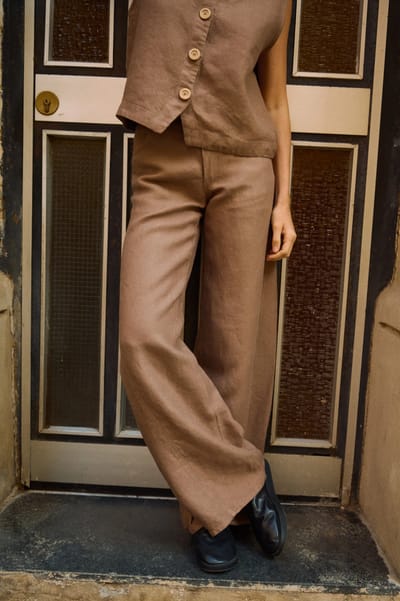
If you want the viscose look with a genuinely natural fiber, linen is the closest match: it has the same cool, breathable, fluid character, it's made from flax by a mostly mechanical process, and it gets better with age instead of more fragile. Organic cotton covers the soft everyday basics, and hemp is the durable workhorse of the family; the full comparison lives in our natural fiber clothing guide. Browse the linen collection or go straight to linen dresses: every product shows its verified fiber composition, so you know it's the real thing.
Live picks: prices and availability updated Sep 23, 2026

Sources & further reading
U.S. Federal Trade Commission (Textile Fiber Products Identification Act and the bamboo/rayon enforcement actions), EU Textile Regulation No 1007/2011 (fiber naming), the EU Best Available Techniques (BAT) framework for polymer production (viscose chemical-recovery benchmarks), Changing Markets Foundation (Dirty Fashion reports, 2017 onward), Canopy / CanopyStyle (forest sourcing and producer audits), Textile Exchange (Materials Market Report, fiber market shares), Lenzing (TENCEL lyocell and EcoVero process claims), Paul David Blanc, Fake Silk: The Lethal History of Viscose Rayon (Yale University Press, 2016), and Scripps Institution of Oceanography / PLOS ONE (Royer et al. 2023, fabric degradation in seawater).
Frequently asked questions
Is viscose a natural fiber?
No. Viscose starts as wood pulp, but the pulp is dissolved in caustic soda and carbon disulfide and re-extruded into thread, a chemical rebuild that makes it a semi-synthetic (regenerated cellulose) fiber. Regulators and standards bodies treat it the same way: GOTS, for instance, won't certify a 100% viscose garment as organic. Plant-derived, yes; natural fiber, no.
Is viscose the same as rayon?
Yes. "Rayon" is the American name and "viscose" the European one for the same fiber, made by the same 1890s process. In the U.S., rayon is the legal umbrella term (with lyocell as a recognized sub-type), while the EU lists viscose, modal, and lyocell as separate fiber names. Whatever the tag says, it's one fiber family.
Is viscose better or worse than polyester?
Environmentally it's a different trade-off. Viscose is cellulose, not plastic, so it doesn't shed persistent microplastics and breaks down in nature far faster: one ocean study saw cellulose fabrics disintegrate in about a month while polyester barely changed after 200 days. On the other hand, viscose production uses toxic carbon disulfide and drives logging for wood pulp, problems polyester doesn't have. Neither is a natural fiber; if that's what you're after, look at linen, cotton, hemp, or wool.
Is viscose good for summer?
It's one of the better non-natural options. Viscose absorbs moisture, breathes, and drapes away from the body, so it wears much cooler than polyester. Its drawback in hot weather is practical: sweat weakens the wet fiber, and viscose often needs delicate washing, a poor fit for clothes you sweat in daily. Linen does the same cooling job while getting softer with every machine wash.
Can you machine-wash viscose?
Check the label first: many viscose garments are dry-clean or hand-wash only, and that's not manufacturer caution for its own sake. Viscose loses roughly half its strength when wet, so agitation and heat can stretch, shrink, or distort it. If the label allows machine washing, use a cold, gentle cycle in a mesh bag and lay flat to dry. Never wring it out while wet.
About the editor
Urša Satler is the founder of Purefect Choice, an online non-toxic goods shop in Slovenia. She stocks what she and her family actually need and use themselves, chosen on material composition and certification.
She started MaterialFilter for a plainly selfish reason: she was tired of checking labels in shops one garment at a time, and tired of hunting for fibre content buried five clicks deep on a product page, usually to discover that a beautiful dress was mostly polyester. MaterialFilter does that checking once, up front, so the composition is the first thing you see instead of the last thing you find.
She sets the standard this site scores against and owns its editorial direction. What she brings to it is the habit of reading a composition label before anything else (daily, for her own family and the shop she runs) and one rule that keeps that habit honest: every claim on MaterialFilter is meant to be checkable against a certification body's own public register, so you never have to take her word for it.